
How Is K-pop Reshaping Urban Space in London?
As of May 2026, the K-pop wave in London continues to grow, becoming increasingly visible across dance communities, cultural events, and everyday urban spaces.
London’s K-pop scene is often introduced through fandom culture — concerts, dance covers, fan meetings, and online communities. While this captures part of the picture, it does not fully explain what is happening on the ground.
What is emerging across the city is something more complex and spatial: a growing network of cultural practices that actively reshape how urban space is used, experienced, and produced.
In this context, K-pop in London is no longer just a music trend. It is becoming a lived urban experience — one that continuously transforms studios, streets, and social spaces through collective participation.
How Do K-pop Fans Create Community Spaces in London?
One of the most visible changes in London’s K-pop scene is how fan communities are no longer simply participating in culture — they are actively curating space.
Dance groups such as KMDC and K-pop Planet UK regularly transform ordinary studios into recurring cultural environments. Based on current 2026 class listings and community reports, KMDC-style classes typically run weekly sessions across multiple London studios with consistent attendance demand and waiting lists during popular choreography cycles. K-pop Planet UK also operates structured training and cover dance programmes that combine performance, filming, and community practice.
These spaces are not just used for dance practice; they function as weekly social environments where people build friendships, routines, and shared identities through movement.
This reflects what cultural geography research describes as “participatory spatial production” — where users actively reconfigure neutral space into cultural space through repetition and collective use (University of Liverpool, LoKo: London K-pop research project, 2024).
Why Can K-pop Choreography Be Seen as a Spatial Practice?
Within London’s K-pop ecosystem, choreography-based activities — including cover dance, workshops, and training sessions — play a central role in shaping how space is experienced.
In 2026, event data from UK community listings shows that London-based Random Play Dance gatherings typically attract between 100–300 participants per event, depending on location and scale. For example, a documented May 2026 event at Central Saint Martins recorded high turnout across a four-hour session, reflecting sustained demand for participatory dance spaces.
As these routines continue over time, studios become associated with specific groups, memories, and creative experiences. They are no longer just places for practice — they become part of London’s evolving K-pop culture.
How Does K-pop Cover Dance Change the Experience of the City?
In London, K-pop cover dance culture does not remain confined to indoor studios.
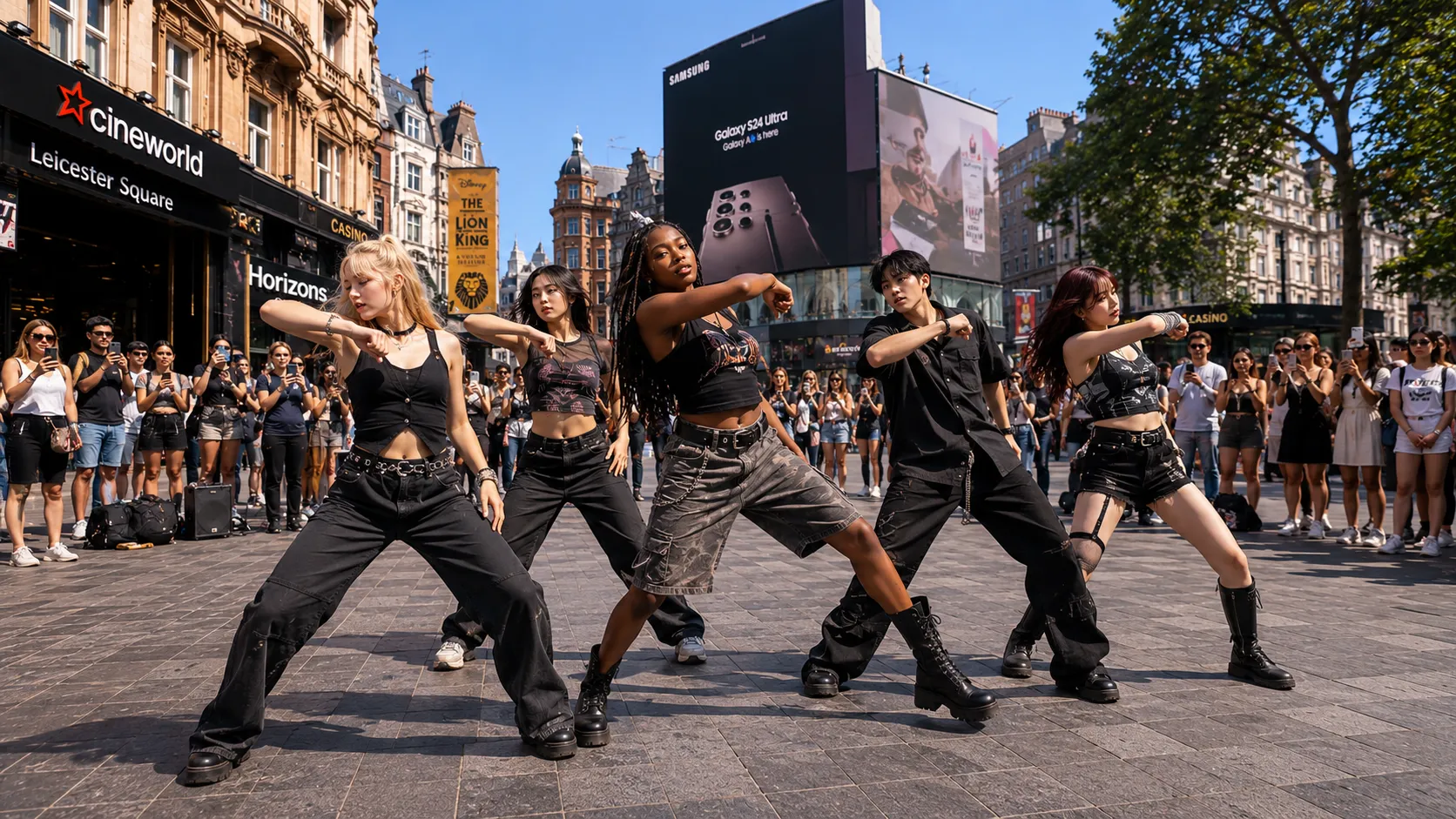
It frequently extends into public and semi-public urban environments, where parks, plazas, and pedestrian streets temporarily become performance spaces. In these moments, the city itself becomes part of the choreography.
Across 2026 listings, outdoor Random Play Dance and Hallyu events in London regularly attract hundreds of participants combined per gathering day, with larger festival formats such as multi-day Hallyu events bringing together K-pop workshops, dance battles, and fan zones across London parks and venues.
These gatherings also generate strong digital amplification, with short-form video content from such events often reaching tens of thousands of views across TikTok and Instagram within days, reinforcing the link between physical space and online visibility.
Why Do Pop-up K-pop Spaces Leave Strong Cultural Memories?
Another defining feature of London’s K-pop scene is the rise of temporary cultural spaces.
Events such as Random Play Dance gatherings, pop-up events, and community-led festivals temporarily transform venues into immersive environments where music, movement, and social interaction come together.
According to 2025–2026 UK fan-community reporting patterns, these events tend to show high repeat attendance behaviour, where participants return across multiple sessions due to strong social bonding effects and recognisable community structure.
In London’s K-pop culture, space is no longer static. It is continuously activated through participation and collective experience.
What Role Do Cultural Institutions Play in K-pop’s Growth?
Alongside grassroots communities, institutions such as the Korean Cultural Centre UK play an important role in shaping the ecosystem.
Through workshops, exhibitions, screenings, and public events, these institutions provide a stable cultural framework that supports the continued visibility of Korean culture in the city.
What makes this relationship particularly interesting is the balance between structure and spontaneity. Institutional spaces provide continuity, while community-led activities bring flexibility, participation, and creative energy.
Together, they form a layered cultural infrastructure across London.
How Do K-pop Stores Function as Social and Cultural Spaces?
K-pop retail spaces in London also reflect this shift.
Stores like Sokollab and independent shops near Euston are not simply commercial spaces. They operate as informal social environments where fans gather, interact, and participate in shared cultural experiences.
During peak K-pop comeback periods, experiential retail spaces in London typically experience noticeable spikes in weekend footfall driven by album releases, pop-up events, and fan meetups, reflecting a broader trend toward community-led retail activation.
What Can London Learn From the Rise of K-pop Culture?
The growth of K-pop culture in London reflects a broader transformation in how contemporary cities function and how cultural identity is produced.
Rather than being defined only by physical location, urban culture is increasingly shaped by how communities move through, activate, and temporarily transform space.
Across dance studios, retail environments, cultural institutions, public events, and urban streets, London’s K-pop scene continuously reshapes space through repetition, participation, and shared experience.
In this sense, K-pop in London is not simply a music trend. It is a powerful example of how culture and urban space continuously co-produce one another in contemporary cities.
Find Creative Spaces for K-pop Activities in London
Whether you are organising a cover dance practice, filming choreography content, hosting a workshop, or planning a community event, finding the right space is part of the experience.
Browse dance studios and creative event spaces used by London’s growing K-pop community.