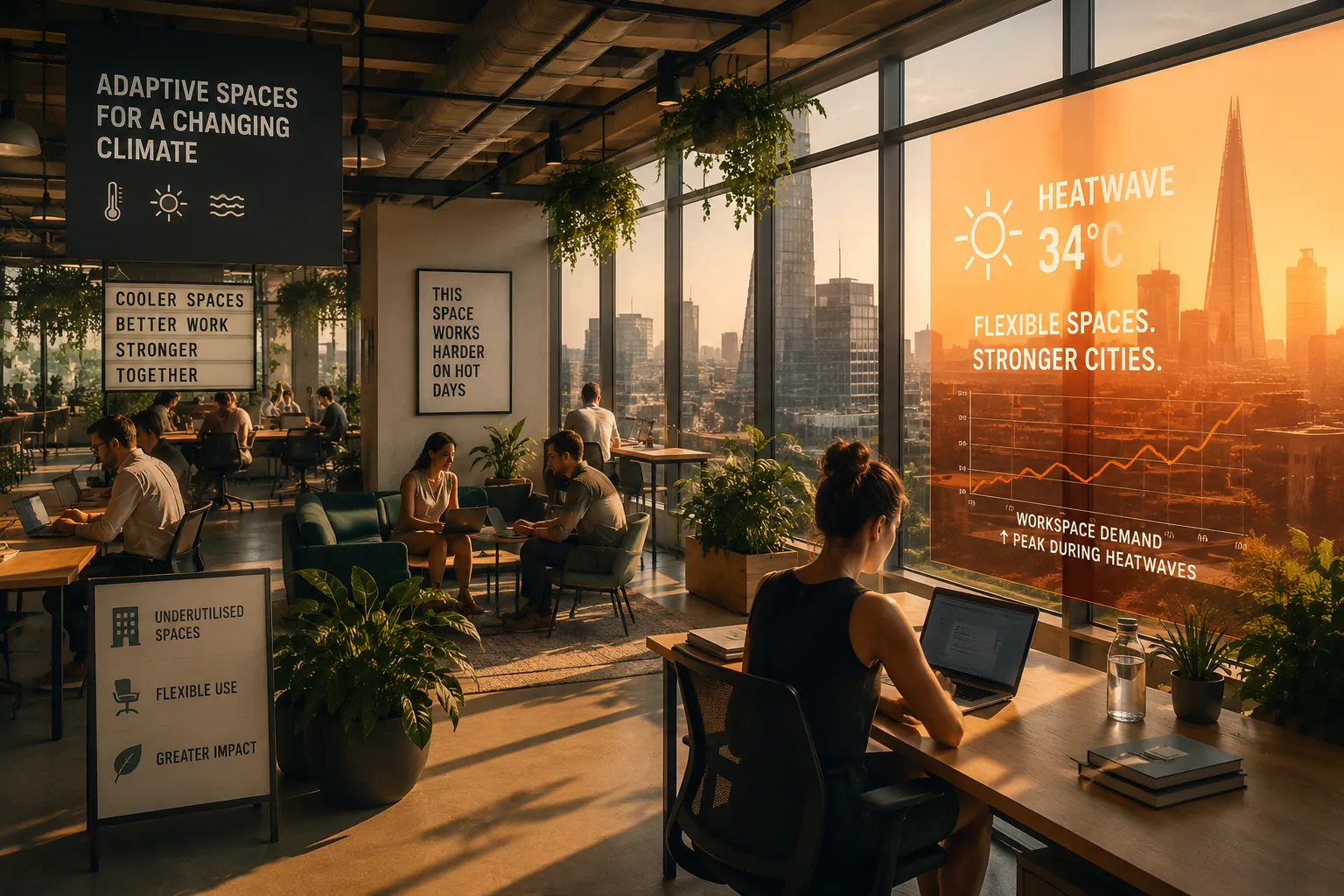

When Weather Starts to Influence Space Demand
The UK is currently experiencing a late June 2026 heatwave, with temperatures in parts of England reaching the low-to-mid 30s and expected to remain elevated over several days. According to BBC reporting on the ongoing conditions, the combination of sustained high temperatures and warm nights is beginning to place pressure not only on transport and public services, but also on everyday routines across cities.
In practical terms, this shift is already visible in how people adapt their working routines during extreme heat. Remote workers who would normally work from home begin seeking alternative environments that offer stable temperatures, reliable connectivity, and a more comfortable working setup.
In many cases, the decision is not about preference, but necessity. Homes without adequate cooling or ventilation become difficult to use for extended periods, particularly during peak afternoon hours when temperatures are at their highest.
As a result, demand does not disappear—it shifts toward spaces that offer controlled environments, comfort, and flexibility, such as coworking spaces, business lounges, and other on-demand work environments.
Why Heatwaves Change How People Use Workspaces
The relationship can be understood quite simply:
Weather → Behaviour Change → Space Demand
As homes become uncomfortably warm during prolonged periods of heat, many remote workers begin to look for alternative environments that better support focus and productivity. Unlike purpose-built offices or coworking spaces, a significant number of residential setups across the UK are not designed for sustained periods of high indoor temperatures.
At the same time, hybrid working has reshaped expectations around workplace flexibility, with 2026 research across the flexible workspace sector showing it has become the default operating model across a large share of knowledge-based industries. This shift is being driven by employee demand for flexibility, productivity gains, and improved work-life balance.
Broader industry data from CBRE further reinforces this trend, showing that office utilisation and hybrid workplace patterns continue to evolve in 2026, reflecting a more distributed model of work across multiple environments rather than a single fixed location.
During periods of extreme heat, this flexibility becomes particularly important. Workers are less likely to rely on fixed office attendance, and more likely to seek out nearby, comfortable, and well-equipped environments that support short-term productivity needs.
Could Underutilised Spaces Become Seasonal Work Hubs?
This shift points to an opportunity that extends beyond traditional coworking models and fixed workspace infrastructure. Across London, a significant amount of retail units, office floors, and community spaces remain underutilised for parts of the day or year, highlighting the potential for existing urban space to function as flexible capacity during periods of peak demand, such as heatwaves.
This idea is already reflected in practice through organisations such as Meanwhile Space, which works with property owners and local authorities to transform vacant buildings into temporary workspaces, studios, and community hubs across London.
Similar approaches are also visible in large-scale urban environments such as Canary Wharf, where commercial spaces are increasingly designed to support mixed-use activation, including events, flexible workspace, and public programming rather than single-use office functions.
Taken together, these examples point to a broader framework where vacant retail units or community spaces could be temporarily activated as short-term work environments during heatwaves, supporting distributed workers who need alternative environments.
The key shift is not new development, but the adaptive use of existing urban space within a changing environmental and economic system.
From Seasonal Demand to Structural Opportunity
Extreme heat events will continue to come and go. However, the underlying shift is increasingly structural. As climate patterns become less predictable and hybrid working becomes further embedded, the relationship between environmental conditions and workspace demand is becoming harder to ignore.
For venue operators and property owners, this changes how demand is understood. It is no longer shaped only by infrastructure, location, or investment cycles, but also by the immediate conditions that influence how people experience and use cities on a day-to-day basis.
In this context, some of the most interesting opportunities may not come from building more space, but from rethinking how existing space is used, activated, and adapted over time.
For many cities, this shift is not about extreme heat alone, but about a broader rethinking of how space is utilised under changing environmental and economic conditions. As demand becomes more fluid and less predictable, the ability to flexibly activate existing assets may become as important as developing new ones.
Could your unused space become a summer coworking hub?
👉 See what you can earn from your unused space