
When London Heatwaves Disrupt Work from Home Productivity
In late May 2026, London briefly reached 35°C during an early-summer heatwave, before thunderstorms followed shortly after, according to ITV News.
It was another reminder that UK summers are becoming increasingly unstable. Less visible, however, was what this meant for work from home productivity across the city.
For many working remotely, the heatwave did not simply create discomfort. It disrupted the working day itself. Homes, typically used as remote working spaces, struggled to maintain focus and comfort under sustained heat.
The assumption that work from home setups are always stable is beginning to feel less reliable.
Why Work from Home in the UK Is Struggling During Heatwaves
Work from home in the UK has become a standard model across many industries, offering flexibility and reduced commuting. But rising heatwaves are exposing structural limits in how domestic spaces function as workplaces.
This is increasingly visible rather than theoretical. The Met Office has noted that heatwaves are becoming more frequent, longer, and more intense across the UK and wider Europe.
At the same time, BBC News has reported that many UK homes—particularly in urban areas like London—were not designed for sustained high temperatures, making them difficult to live and work in during prolonged heat periods.
Most homes are not built for prolonged heat exposure, making remote working less stable during summer peaks. Productivity drops, concentration weakens, and work becomes fragmented. In London, people rely on fans, blackout curtains, and earlier working hours, but these only go so far. The gap between an ideal work from home setup and real conditions is increasingly hard to ignore.
The Less Visible Cost of Heat
The impact of heat is not only physical, but cognitive. Sustained exposure to high temperatures reduces concentration and increases fatigue during extended screen-based work, with effects accumulating over the course of the day.
A 2026 study on labour productivity under heat stress found consistent declines in output during heatwave conditions across advanced economies, aligning with what many remote workers experience in summer periods.
In London, recent heatwaves have been linked to earlier peaks in co-working space usage and quieter afternoons, as home environments become harder to sustain without cooling. Similar behavioural shifts have been observed across Europe. At the same time, UK retail data from the 2026 heatwave period showed a sharp rise in fan and cooling product sales, reflecting household adaptation to sustained heat.
What begins as a seasonal inconvenience gradually becomes a productivity constraint.
The Return of Shared Workspaces and Hot Desking in London
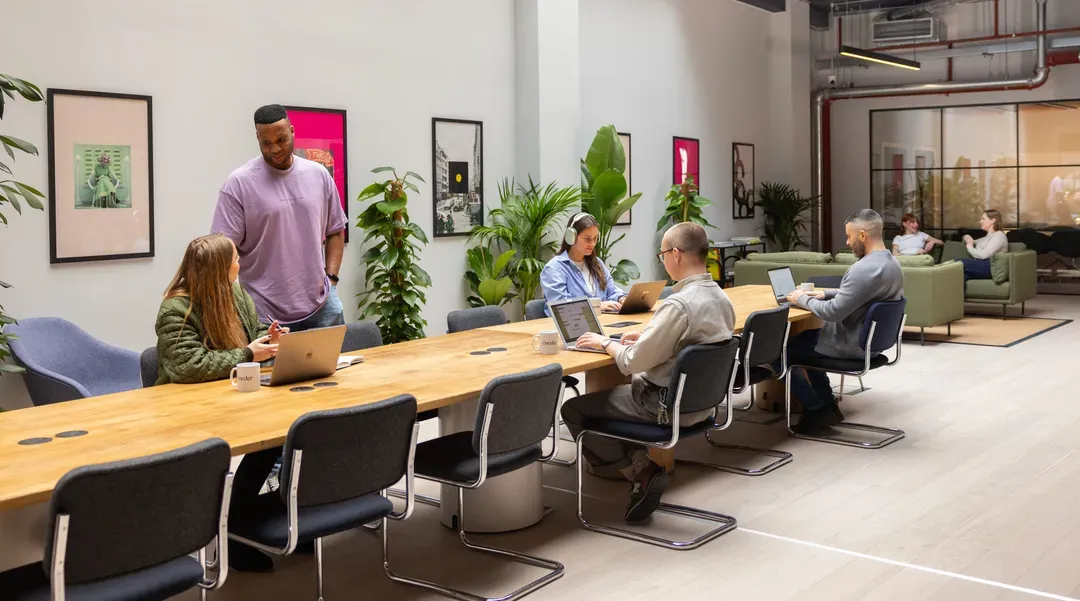
As home environments come under strain, hot desking in London and co-working spaces are becoming increasingly relevant.
Hot desking offers flexible access to structured work environments without fixed seating. The appeal is practical rather than ideological: a workspace that functions consistently regardless of external conditions.
Unlike most homes, coworking spaces in London are designed with climate control, acoustic stability, and structured layouts as standard infrastructure rather than optional comfort.
Examples such as The Workers League and Laundry Studios reflect this shift, offering flexible environments for freelancers, remote workers, and small teams outside traditional office models. Beyond comfort, these spaces reintroduce rhythm into the working day. Leaving home to work in a shared environment restores a boundary that remote working often blurs.
They also encourage informal interaction. Conversations between professionals from different fields can lead to collaboration or new work.
Who Uses Co-working Spaces and Hot Desking in London?
The user base for co-working spaces in London has broadened well beyond early adopters. Freelancers and independent professionals remain central, drawn by flexibility without long-term commitments. Start-ups use shared offices to reduce overheads while maintaining operational structure.
Increasingly, hybrid workers also rely on these environments when work from home setups become inefficient during extreme heat. Workspace choice is therefore becoming less about convenience and more about reliability under stress.
Future of Work: Flexible Workspaces Beyond Work from Home
As working patterns continue to shift between office, home, and hybrid models, access to flexible and reliable environments is becoming increasingly important in cities like London, where productivity is now shaped less by fixed workplaces and more by changing conditions such as focus, temperature, and timing.
This is reflected in the rise of hot desking spaces and co-working environments, which are increasingly functioning not as lifestyle choices but as practical responses to how and where people actually work.
Platforms such as SpaceCloud sit within this shift, offering access to both hot desks and meeting rooms across the city, while reinforcing a broader change in which flexibility is becoming part of how London itself is experienced and navigated on a daily basis.
👉 Explore hot desks in London on SpaceCloud